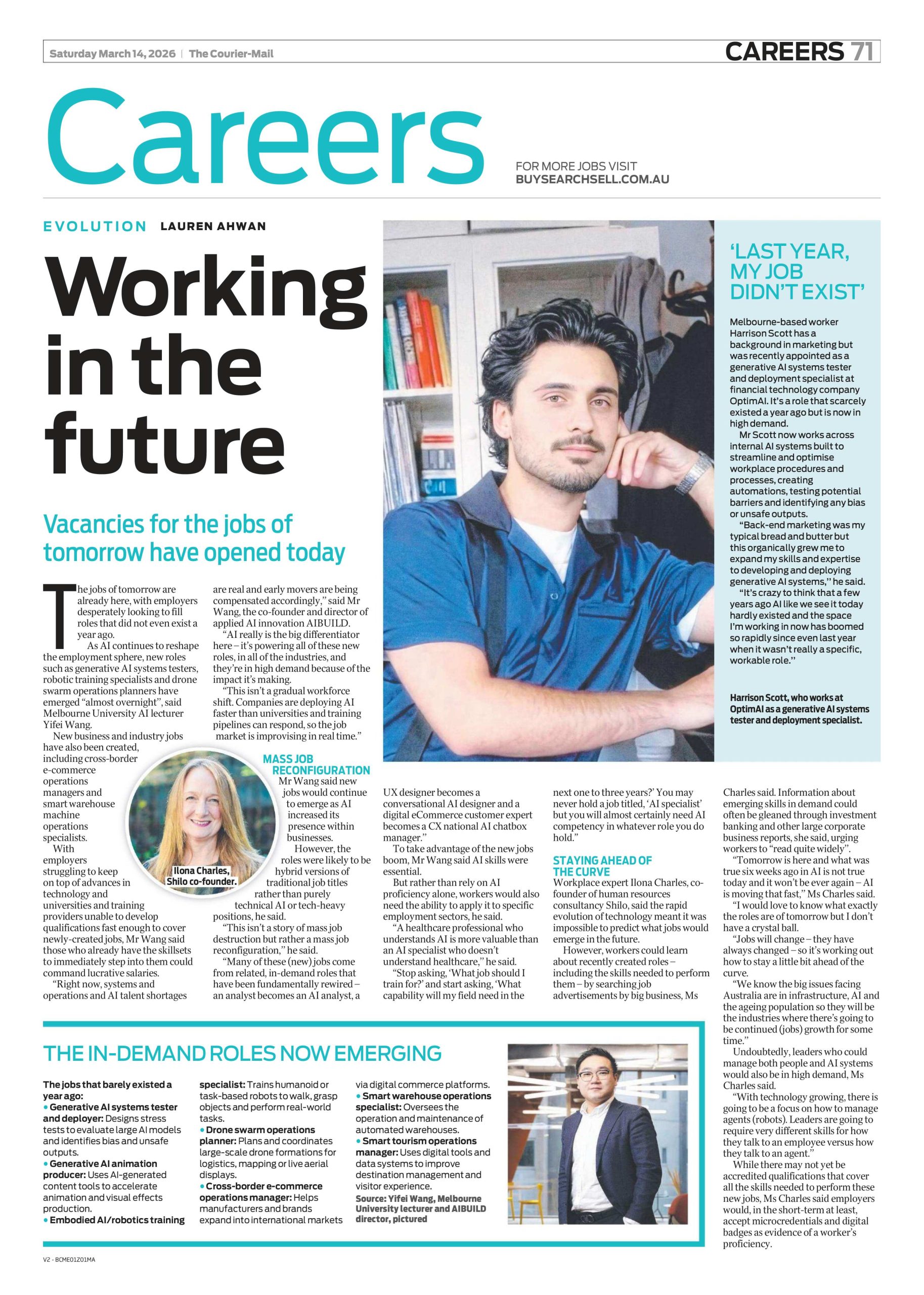

Featured article in the Courier Mail with Ilona Charles, Executive Director – CEO & Co-founder at shilo.
In this article, Ilona shares her thoughts on how rapidly roles are shifting, why AI is accelerating change, and how individuals can stay one step ahead.
Vacancies for the jobs of tomorrow have opened today
The jobs of tomorrow are already here, with employers desperately looking to fill roles that did not even exist a year ago. As AI continues to reshape the employment sphere, new roles such as generative AI systems testers, robotic training specialists and drone swarm operations planners have emerged “almost overnight’’, said Melbourne University AI lecturer Yifei Wang. New business and industry jobs have also been created, including cross-border e-commerce operations managers and smart warehouse machine operations specialists.
With employers struggling to keep on top of advances in technology and universities and training providers unable to develop qualifications fast enough to cover newly-created jobs, Mr Wang said those who already have the skillsets to immediately step into them could command lucrative salaries. “Right now, systems and operations and AI talent shortages are real and early movers are being compensated accordingly,’’ said Mr Wang, the co-founder and director of applied AI innovation AIBUILD. “AI really is the big differentiator here – it’s powering all of these new roles, in all of the industries, and they’re in high demand because of the impact it’s making. “This isn’t a gradual workforce shift. Companies are deploying AI faster than universities and training pipelines can respond, so the job market is improvising in real time.’’
Mass Job Reconfiguration
Mr Wang said new jobs would continue to emerge as AI increased its presence within businesses. However, the roles were likely to be hybrid versions of traditional job titles rather than purely technical AI or tech-heavy positions, he said. “This isn’t a story of mass job destruction but rather a mass job reconfiguration,’’ he said. “Many of these (new) jobs come from related, in-demand roles that have been fundamentally rewired – an analyst becomes an AI analyst, a UX designer becomes a conversational AI designer and a digital eCommerce customer expert becomes a CX national AI chatbox manager.’’ To take advantage of the new jobs boom, Mr Wang said AI skills were essential. But rather than rely on AI proficiency alone, workers would also need the ability to apply it to specific employment sectors, he said. “A healthcare professional who understands AI is more valuable than an AI specialist who doesn’t understand healthcare,’’ he said. “Stop asking, ‘What job should I train for?’ and start asking, ‘What capability will my field need in the next one to three years?’ You may
never hold a job titled, ‘AI specialist’ but you will almost certainly need AI competency in whatever role you do hold.’’
Staying Ahead of the Curve
Workplace expert Ilona Charles, co-founder of human resources consultancy Shilo, said the rapid evolution of technology meant it was impossible to predict what jobs would emerge in the future. However, workers could learn about recently created roles – including the skills needed to perform them – by searching job advertisements by big business, Ms Charles said. Information about emerging skills in demand could often be gleaned through investment banking and other large corporate business reports, she said, urging workers to “read quite widely’’. “Tomorrow is here and what was true six weeks ago in AI is not true today and it won’t be ever again – AI is moving that fast,’’ Ms Charles said. “I would love to know what exactly the roles are of tomorrow but I don’t have a crystal ball. “Jobs will change – they have always changed – so it’s working out how to stay a little bit ahead of the curve.
“We know the big issues facing Australia are in infrastructure, AI and the ageing population so they will be the industries where there’s going to be continued (jobs) growth for some time.’’ Undoubtedly, leaders who could manage both people and AI systems would also be in high demand, Ms Charles said. “With technology growing, there is going to be a focus on how to manage agents (robots). Leaders are going to require very different skills for how they talk to an employee versus how they talk to an agent.’’ While there may not yet be accredited qualifications that cover all the skills needed to perform these new jobs, Ms Charles said employers would, in the short-term at least, accept microcredentials and digital badges as evidence of a worker’s proficiency.